 blog
7 Things to Look For in an Indian Wedding Photographer
Table of Contents
- Why Choosing the Right Indian Wedding Photographer Matters
- 1. Real Experience With Indian Wedding Rituals and Customs
- 2. An Indian Wedding Photography Portfolio You Can Evaluate Properly
- 5. An Indian Wedding Photography Shot List Built Around Your Day
- 6. Clear Contract Terms, Image Rights and Delivery Timelines
- 7. Communication Style, Discretion and Respect for Family Priorities
- Frequently Asked Questions
Last Updated: October 20, 2026
Why Choosing the Right Indian Wedding Photographer Matters
Booking the wrong photographer for a multi-day wedding is an expensive mistake. You cannot reshoot a Nikah or an Anand Karaj.
Choosing an Indian wedding photographer is not the same as booking someone for a standard registry ceremony.
Below, we break down the seven things worth checking before you pay a deposit. Each one has a question you can ask on the day.
1. Real Experience With Indian Wedding Rituals and Customs
Cultural knowledge is the first thing to check, and it is the hardest to fake. Ask how many Indian, Sikh or Muslim weddings the photographer has covered, and ask them to name the rituals they plan around.
What Cultural Knowledge Actually Looks Like on the Day
A photographer who knows the ceremony will already be in position before the moment happens. They know the Anand Karaj involves four laavan, and they know the Nikah signing draws the family close together. They know when the doli happens and where the light will fall.
A common mistake is assuming any good wedding photographer can adapt. In practice, the missed shots are almost always ritual moments nobody anticipated.
Ask directly:
- Which rituals do you plan your timeline around?
- How do you handle the women getting ready, where privacy matters?
- Can you name the key moments in our ceremony without prompting?
If the answers are vague, keep looking.
2. An Indian Wedding Photography Portfolio You Can Evaluate Properly
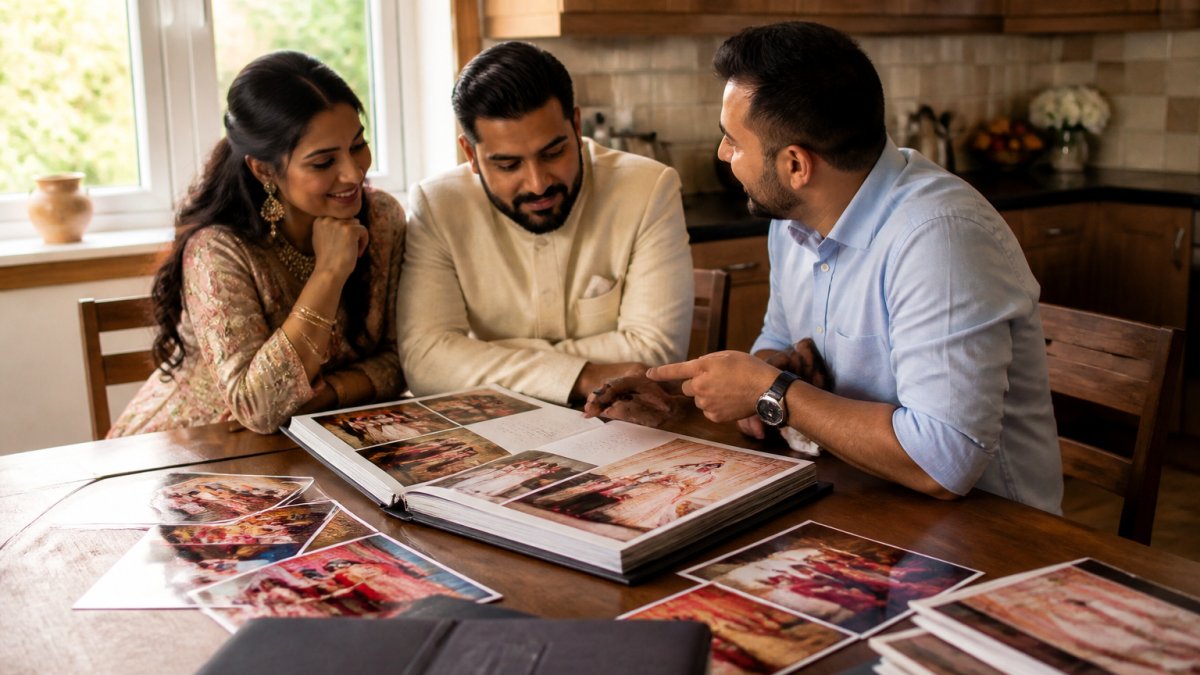
An Indian wedding photography portfolio should be judged on full galleries, not a two-minute reel. Anyone can assemble twenty perfect frames. A complete wedding gallery shows you consistency across a whole day.
Team Size, Backup Coverage and Simultaneous Ceremonies
This is where many bookings fall apart. Two ceremonies can overlap, and one photographer cannot be in two places. Ask how the team splits when the mehndi and the sangeet run close together, and ask who is the lead on each day.
A workable structure for a three-day wedding usually looks like this:
- Lead photographer who owns the timeline and the couple's priorities across all days
- Second photographer for the ceremony itself, covering the couple's faces and the family reactions at the same time
- Assistant or lighting support for large mandaps, marquees and evening receptions where flash and reflectors are needed
Ask for the names and roles in writing. A studio that cannot tell you who will be in the room on each day is a studio that has not planned your wedding.
What the Package Should Specify
Cover the practical points and get them into the quote, not just the sales conversation:
- Days and hours covered, including getting-ready time and any travel between venues
- Number of photographers per event, and whether that changes on the main ceremony day
- Edited image count per day, and whether unedited files are included or available on request
How Pricing Is Actually Built
Pricing depends on the number of days, the number of locations, the team size and the deliverables you choose.
Ask any studio for a written quote against your actual itinerary, and ask them to itemise the days, the team and the deliverables separately. That breakdown lets you compare two quotes fairly, because a lower headline figure often hides a smaller team or a longer delivery window.
Questions That Expose a Thin Package
- Who is the lead on each day, and who is the second?
- What happens if the lead is ill on the morning of the ceremony?
- How many edited images should we expect per day?
- When will the full gallery be delivered, and is that date in the contract?
If the answers are vague, or the team size shrinks when you ask for it in writing, keep looking. The package is the part of the booking you can hold a studio to, so it should be specific enough to compare against another quote line by line.
5. An Indian Wedding Photography Shot List Built Around Your Day
An Indian wedding photography shot list is the bridge between your family's priorities and the photographer's plan.
Start with the must-capture moments: the getting ready, the ceremony itself, the vidai or rukhsati, and the family portraits.
Then map the timeline.
Ask the photographer to share their standard shot list. Compare it with yours. The gaps tell you what to discuss.
6. Clear Contract Terms, Image Rights and Delivery Timelines
Contract terms decide what happens when something goes wrong, so read them properly. The agreement should state the deliverables, the delivery timeline, image usage rights and the cancellation policy.
Check these points in writing:
- Number of edited images and whether unedited files are included
- Turnaround time for the full wedding gallery and any album
- Image usage rights, including whether you can print and share freely
- Social media consent, so you control what is published and when
7. Communication Style, Discretion and Respect for Family Priorities
Communication style is the soft skill that decides how the day feels. You will spend hours with this person, often in private and emotional moments.
Look for a photographer who listens more than they talk in the consultation.
Family priorities matter too. Some families want formal group photographs with every relative. Others want the photographer to stay in the background.
Couples relax when they trust the person holding the camera.
Frequently Asked Questions
How many hours of coverage do you need for an Indian wedding?
Most multi-day Indian weddings need far more than a single-day package allows. A three-day celebration with a mehndi, a ceremony and a reception can easily run to 30 or more hours of coverage once getting-ready preparations and evening events are counted. Ask each photographer how they structure wedding photography packages and coverage across multiple days and venues, whether travel time between locations is included, and whether a second photographer covers the getting-ready hours while the lead covers the ceremony.
What should you check in an Indian wedding photography portfolio?
Ask to see two or three complete wedding galleries rather than a highlight slideshow. A strong Indian wedding photography portfolio should show consistent quality across dimly lit ceremonies, outdoor daytime events and crowded reception halls. Look for images of the key rituals, family group photographs and candid moments, not just couple portraits. Check whether skin tones and colourful attire are rendered accurately, and whether the same standard holds from the first image to the last.
What questions should you ask an Indian wedding photographer before booking?
Ask how many Indian weddings they have photographed in the past two years, who will actually shoot on the day, and what happens if they fall ill. Request the contract and read the cancellation, image usage and delivery clauses. Ask how they handle sensitive moments such as getting-ready preparations, and how they coordinate with your wedding coordinator and family. A good photographer answers these without hesitation and can give you a clear Indian wedding photography shot list tailored to your ceremonies.
Why does experience with Indian weddings matter when choosing a photographer?
A photographer who knows the order of a Hindu ceremony, when the Anand Karaj vows happen, or how a Nikah is structured can position themselves before a moment arrives rather than reacting after it has passed. That knowledge also shapes the Indian wedding photography shot list: knowing which family members need to be in group photographs, where the couple will be seated, and how long each ritual lasts. Without it, important moments can be missed while the photographer works out what is happening.
Planning a multi-day wedding is stressful enough without worrying whether your photographer will miss the moments that matter. At Khush Studio, we bring over 20 years of experience with Indian, Sikh and Muslim weddings, a discreet approach to sensitive moments, and tailored photography and videography packages built around your itinerary. Get in touch with Khush Studio and start with a conversation about your day.