 Ultimate guide
How to Plan Photography for a Sikh Wedding Reception
Last Updated: October 29, 2026
Quick Summary
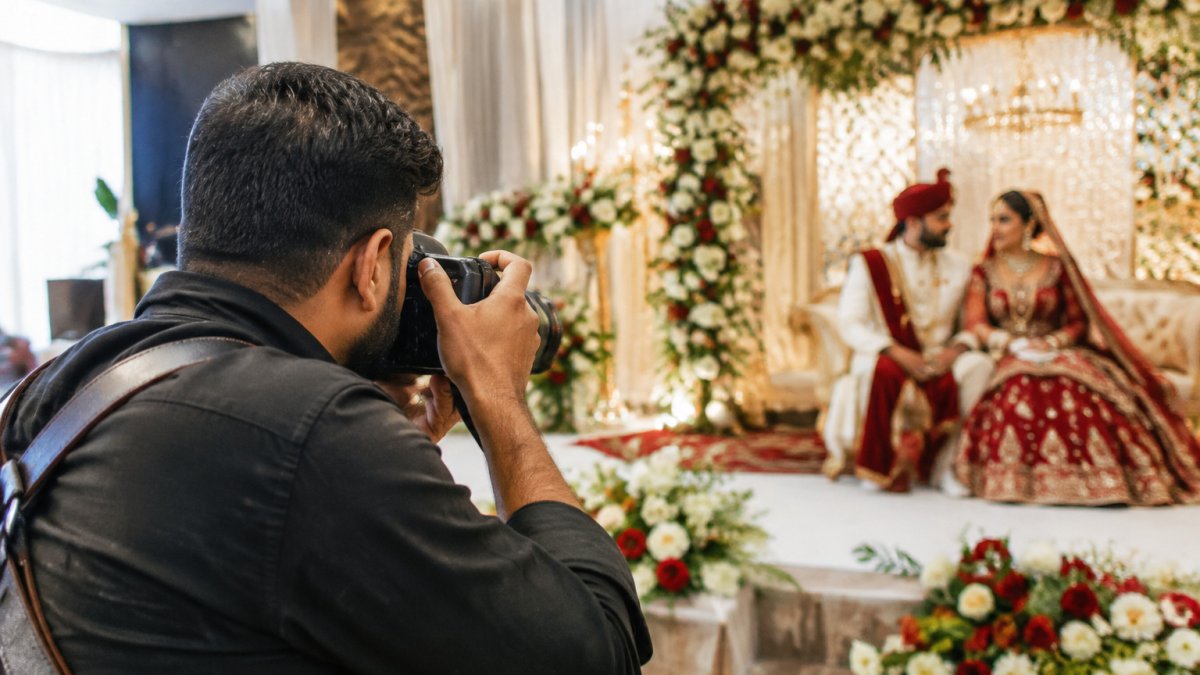
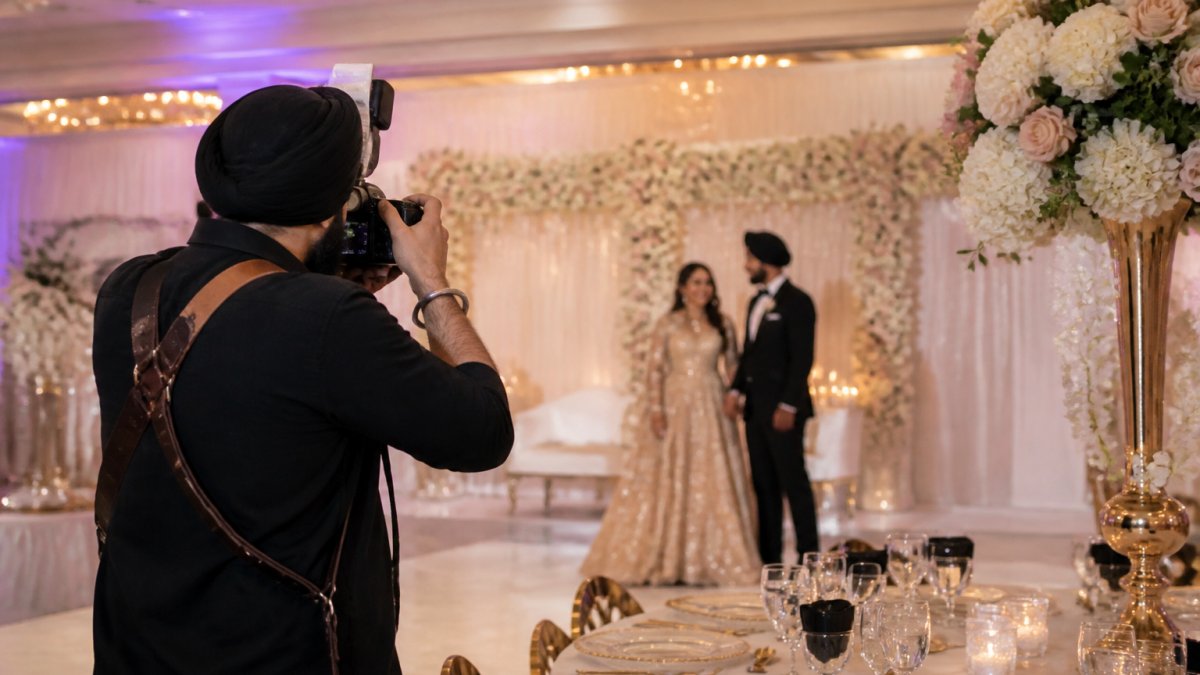
To plan photography for a Sikh wedding reception, build the timeline around fixed moments first: arrivals, the couple's entrance, speeches, cake cutting and the dance floor. Then create a prioritised shot list grouped by moment and share it with your photographer at least a fortnight before the day.
- Ask your venue and caterer for the running order they will actually follow before building the timeline.
- Allow 45-60 minutes for guest arrivals and 60-90 minutes for dance floor coverage.
- Agree a red list of no more than five frames that must be captured regardless of schedule slippage.
- Visit the venue before the day and test the light, confirming whether lighting levels change during speeches.
- Circulate one shared document a fortnight ahead with the running order, shot list, lighting cues and wet-weather plan.
Table of Contents
- Start With the Reception Schedule, Not the Photos
- Building a Sikh Wedding Photography Timeline That Holds
- The Sikh wedding reception shot list You Actually Need
- Indian Wedding Photography Lighting Tips for Evening Receptions
- Coordinating the Gurdwara Ceremony With the Reception Coverage
- Group Photographs, Family Portraits and Guest Flow
- Vendor Coordination, Backup Plans and the Rain Contingency
- From Digital Gallery to Album Design After the Reception
- Frequently Asked Questions
Start With the Reception Schedule, Not the Photos
Most couples begin planning photography for a Sikh wedding reception by collecting shot lists from Pinterest. That is the wrong starting point. The reception coverage that works is built backwards from the schedule, not forwards from a mood board.
A Sikh wedding reception is a fixed sequence of moments: arrivals, the couple's entrance, speeches, dinner service, cake, and the dance floor. If you are unsure what actually happens at a Sikh wedding, what can you expect at a Sikh wedding ceremony walks through the events so you can anchor your schedule to fixed moments.
Build the Sikh Wedding Photography Timeline Around Fixed Moments
A Sikh wedding photography timeline is a working document that lists every reception event with a start time, a duration, and the coverage it needs.
Start by asking your venue and caterer for the running order they will actually follow. Then mark the moments that cannot move: the speeches, the couple's entrance, and the cake cutting.
The moments that cannot move come first. Everything else is negotiable.
Building a Sikh Wedding Photography Timeline That Holds
A timeline only holds if it accounts for the gaps nobody plans for. Guests arrive late. Speeches run long. Dinner service slips by twenty minutes. Build slack into the schedule rather than assuming the best case.
For multi-day celebrations, the same principle scales up. Our tips for multi day wedding photography cover how to allocate coverage hours and timelines across every event.
How Long to Allocate for Each Stage
| Stage | Suggested Allowance | Notes |
|---|---|---|
| Guest arrivals and drinks | 45-60 minutes | Candid coverage, no posing |
| Couple's entrance | 10-15 minutes | Confirm the route with the venue in advance |
| Speeches | Actual runtime plus 15 minutes | Ask for speech lengths beforehand |
| Group photographs | 30-45 minutes | Split into two blocks to avoid guest fatigue |
| Couple portraits | 20-30 minutes | Best scheduled during dinner service |
| Dance floor | 60-90 minutes | Peak energy is usually the first hour |
Treat these as starting points, not rules. A reception with six speeches needs a different shape from one with two.
The Sikh wedding reception shot list You Actually Need
A Sikh wedding reception shot list is a prioritised document, not a catalogue of every photograph you have ever seen online. The best lists are short, grouped by moment, and shared with your photographer at least a fortnight before the day.
The Must-Have Reception Shots, Grouped by Moment
Use this as a working checklist. For a ready-made template to build your own shot list from, see our Indian wedding photography checklist. Tick off what applies to your family, delete what does not, and add the personal details only you know about.
Arrivals and welcome
- Couple greeting guests at the entrance, both wide and close
- Grandparents and elders arriving, seated and being greeted
- The welcome table, seating plan and any personalised signage
Couple's entrance
- The announcement moment, captured from the back of the room and from the side of the stage
- The couple's first look at each other as they enter
- Confetti, petals or sparklers if used
Speeches and toasts
- Each speaker at the microphone, plus a wider frame showing the top table's reaction
- The couple's faces during each speech, these are often the most emotive frames of the night
- The raised glass or toast moment
Rituals and cultural moments
- The cake cutting, including the couple's hands on the knife and the first slice shared
- Any family blessing or prayer before the meal
- The first dance, plus the moment parents or siblings join
Details
- The embroidered dupatta, the couple's outfits and any heirloom jewellery
- Table centrepieces, favours and the cake before it is cut
- The menu card or place settings, if they reflect the family's story
Dance floor
- The first hour of dancing, when energy peaks
- Bhangra or group dance formations, shot from a raised angle
- Candid frames of guests who rarely dance
How to Prioritise the List
Group the list by moment: arrivals, entrance, speeches, rituals, details, dance floor. Then mark the three or four shots that are non-negotiable. If the evening runs short, those are the ones your photographer protects.
Name the details that matter to your family, not just the ones that photograph well. A grandparent's reaction during a speech. The specific family members who must appear together in one frame.
Indian Wedding Photography Lighting Tips for Evening Receptions
Evening receptions are where photography plans most often fail.
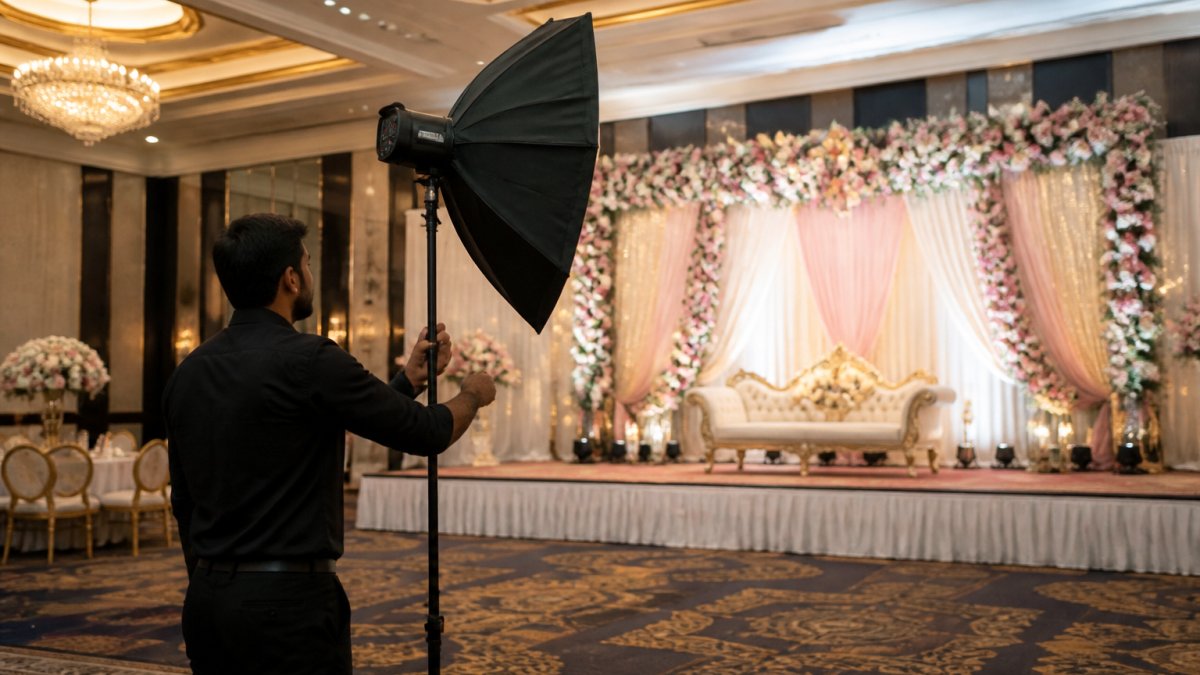
Ask your photographer whether they use off-camera flash and how they balance it with the venue's ambient lighting. Direct on-camera flash flattens skin tones and washes out fabric detail.
Watch out: venues that dim the lights during speeches will defeat any plan built on ambient light alone. Confirm with the venue whether lighting levels change during the evening, and pass that answer to your photographer.
Coordinating the Gurdwara Ceremony With the Reception Coverage
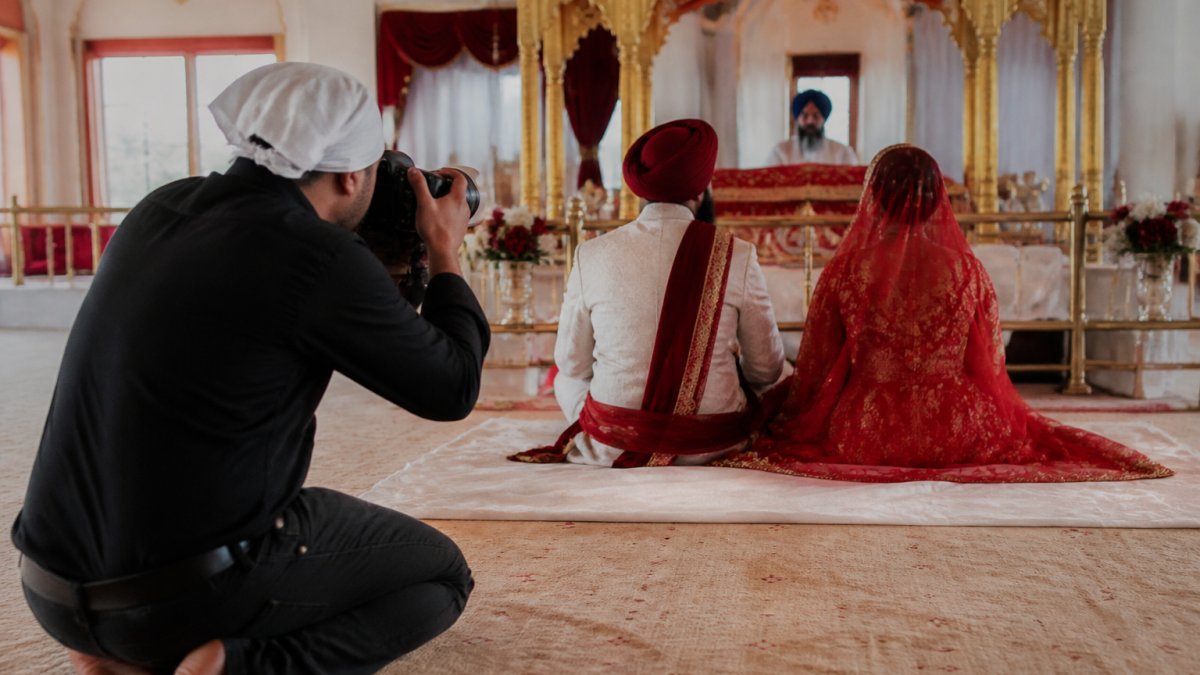
The Anand Karaj and the reception are two different photographic jobs. The ceremony is quiet, ritual-led and bound by etiquette; the reception is social, loud and fast-moving. To plan coverage around it, learn the Anand Karaj ceremony order and etiquette.
Coverage hours matter here. A multi-day schedule spanning the gurdwara, the Langar hall and an evening reception needs realistic hours attached to each event.
Group Photographs, Family Portraits and Guest Flow
Group photographs are the most logistically demanding part of any reception, and the most likely to eat into your evening.
Split the list into two blocks. Take the largest family groups immediately after arrivals, before guests settle at tables. Take the rest during dinner service, when the dance floor is empty and people are easy to move.
Family portraits deserve their own short window. Twenty minutes with the couple and immediate family, scheduled while canapés are served, produces better images than an hour squeezed in at the end of the night.
Vendor Coordination, Backup Plans and the Rain Contingency
Vendor coordination is the quiet work that makes a reception run smoothly. Your photographer needs the venue's event manager, the caterer's serving times, and the DJ or MC's running order. One shared document, circulated a fortnight ahead, prevents most day-of confusion. But the detail that separates a smooth reception from a chaotic one is knowing exactly what each vendor controls and when your photographer needs to intervene.
What to Sync With Each Vendor, and When
Venue event manager
- Confirm the exact times the room lighting changes: dimming for speeches, raising for the dance floor, and any stage lighting cues.
- Ask where the photographer may stand during speeches and the cake cutting, and whether there are any restricted areas.
- Confirm load-in and setup access so the photographer can test light before guests arrive.
Caterer
- Get the serving times for canapés, dinner and cake, because these are the windows when group photographs and couple portraits are easiest to take.
- Ask whether the couple's portraits can be scheduled during the main course, when guests are seated and the dance floor is empty.
- Confirm whether the cake is cut before or after dinner, as this changes the shot list order.
DJ or MC
- Share the running order so announcements do not collide with speeches or the couple's entrance.
- Ask for the first-dance track and timing, and whether there will be a choreographed performance.
- Confirm whether the DJ will use haze, strobes or moving lights, as these affect exposure and focus.
Planner or coordinator, if booked
- Make them the single point of contact for schedule changes on the day, so the photographer is not fielding questions from three directions.
The Rain Contingency for an Indoor Reception
Weather matters even for indoor receptions. Guests arrive in rain, outdoor portrait plans collapse, and arrival coverage moves under cover. Agree a wet-weather alternative for portraits before the day: a covered entrance, a lobby with good natural light, or a decorated indoor corner that can be lit artificially.
Check two things with the venue: whether there is a covered drop-off point for guests, and whether any outdoor space booked for drinks or portraits has an indoor equivalent of similar size.
The Shared Document That Prevents Most Problems
Circulate one document a fortnight ahead containing the running order, the shot list, the vendor contact list, the lighting cues and the wet-weather plan. Ask every vendor to confirm they have read it. On the day, the photographer carries a printed copy and the planner or venue manager holds the master version.
If you are ready to talk through coverage, get in touch with Khush Studio to discuss your reception plan.
From Digital Gallery to Album Design After the Reception
The work does not end when the last guest leaves.
Ask about the delivery timeline for your digital gallery, and how many images you should expect.
Post-wedding speeches and family portraits often become the heart of the album. Make sure the design brief reflects that.
Planning a Sikh wedding reception is a scheduling problem before it is a photography problem.
Frequently Asked Questions
What are the key moments to capture at a Sikh wedding reception?
The moments guests most often regret missing are the couple's entrance, the first speeches and the family reactions during them, the cake cutting, and the dance floor once it fills. Add the Anand Karaj if any part of it is recreated or referenced at the reception, plus the Langar hall or food service if it is part of the evening. Put all of these on the Sikh wedding reception shot list with approximate times so your photographer knows where to stand before each one begins.
How do you coordinate photography between the Gurdwara ceremony and the reception?
Treat them as two separate coverage blocks with a travel gap between them. Confirm the Gurdwara's own rules on photography first, since some venues restrict flash or movement during the Anand Karaj. Then give your photographer the reception venue's access time so they can arrive before guests and set up lighting. A written schedule shared with the venue coordinator, the photographer and one family contact prevents the gap between the two events from eating into reception coverage.
What lighting tips are essential for evening Sikh wedding receptions?
Visit the venue after dark before the wedding and look at how the room is actually lit, not how it looks in daylight. Most banqueting halls have dim ambient light and coloured uplighting, which pushes cameras to slow shutter speeds. Ask your photographer whether they use off-camera flash, and check whether the venue allows stands and modifiers. Confirm whether the stage and dance floor can be lit separately, and ask about smoke machines or haze, which scatter flash and change the look of every image.
How long should I allocate for reception photography in my wedding timeline?
Plan reception coverage around the fixed moments rather than a flat number of hours. Couple portraits usually need 20 to 30 minutes, group photographs with immediate family around 30 to 45 minutes, and speeches plus reactions at least an hour if there are several speakers. Build in a buffer before the entrance and after the first dance. If your celebration runs across several days and venues, confirm the coverage hours in writing so you know exactly when the photographer arrives and leaves.