 How-to
How Do You Keep Nikah Wedding Photos Private?
Last Updated: November 20, 2026
Quick Summary
Ensuring privacy during nikah wedding photography starts with the couple deciding what is photographed, who sees it, and where it appears, confirmed in a written privacy agreement alongside the main contract. Ask your photographer plainly and early to keep images private, and confirm in writing that no images may be published on their website, blog, portfolio or social media.
- Hold a pre-wedding privacy consultation and bring a written list of off-limits moments.
- Ask for contract clauses covering image publication, photo release, vendor sharing, social media and deletion.
- Announce guest phone rules twice and assign one point person per side.
- Mark each shot on the shot list as open, restricted or private.
- Confirm gallery access, retention periods and deletion in writing before delivery.
Table of Contents
- Why Privacy Matters in Nikah Wedding Photography
- Agreeing on Privacy Preferences Before the Wedding
- What a Wedding Photography Privacy Agreement Should Cover
- How to Ask a Photographer Not to Post Photos
- Wedding Photo Sharing Rules for Guests
- Building a Nikah Photography Shot List Around Privacy
- Keeping Coverage Discreet on the Day
- Secure Delivery, Retention and Deletion of Images
- Frequently Asked Questions
Why Privacy Matters in Nikah Wedding Photography
Ensuring privacy during nikah wedding photography starts with one clear rule: the couple decides what is photographed, who sees it, and where it appears. A Nikah is an intimate act of worship before it is a celebration, and many families treat images of it as something to protect, not publish. The questions couples ask most often are about modesty and control, not poses.
That changes how a photographer should work. Privacy is not an afterthought bolted onto the contract. It shapes the brief, the shot list, the camera position and even how files are stored afterwards.
Nikah wedding photography done well respects three things at once: religious custom, family expectation, and the couple's own comfort. Get those right and the images feel warm rather than intrusive.
If you want to go deeper on consent and guest briefing, our guide on how to respect privacy during a Nikah ceremony walks through the ceremony itself.
Agreeing on Privacy Preferences Before the Wedding
The most useful conversation happens weeks before the day, not on it. A common approach is a short pre-wedding consultation where the couple lists what must never be photographed, what can be photographed but not shared, and what is open.
The Pre-Wedding Privacy Conversation
Bring a written list to that meeting. Cover these points:
- Which ceremony moments are off-limits entirely
- Whether the bride's getting-ready room allows any camera
- Who may appear in family portraits, and who has asked not to
- Whether gender-segregated spaces need a female photographer
- Which images may appear on social media, and which stay private
Many families find it easier to send this in writing after the meeting. That gives everyone a record and removes guesswork.
What a Wedding Photography Privacy Agreement Should Cover
A wedding photography privacy agreement is a written record of what the couple permits and what the photographer will do with the images. It should sit alongside the main contract, not replace it.
Contract Clauses and Image-Use Permissions
Ask for these clauses in writing:
- Image publication: whether any photo may appear in a portfolio, blog or award entry
- Photo release: how and when the couple gives permission, and whether it can be withdrawn
- Vendor sharing: whether images may go to the caterer, decorator or venue
- Social media: which platforms, if any, and whether tagging is allowed
- Retention and deletion: how long files are kept and when they are destroyed
If you are comparing packages, our breakdown of private Nikah photography packages sets out what privacy terms typically include and the questions to ask before booking.
How to Ask a Photographer Not to Post Photos
Say it plainly and early: "We would like our images kept private and not shared online." A professional will not be offended. Most will simply add it to the brief.
Then confirm it in writing. A short email works:
"To confirm our conversation: no images from our Nikah may be published on your website, blog, portfolio or social media. Private gallery access only, for named family members. Please confirm by reply."
Two things make this stick. First, ask for the answer in writing, not verbally. Second, ask what happens if a request is missed, and who to contact.
Vetting matters as much as asking. Our guide on what to look for in Muslim wedding photographers covers cultural knowledge and modesty practice, plus the exact questions to put to a photographer before you book.
Wedding Photo Sharing Rules for Guests
Guests with phones are a common privacy concern at weddings, and a Nikah is no exception. A clear, kind policy works better than a strict one nobody follows. The difference between a policy that holds and one that collapses is whether you have planned the announcement, the enforcement, and the exceptions before the day.
Set out your wedding photo sharing rules for guests in four places: the invitation, a small sign at the entrance, a spoken announcement before the ceremony begins, and a named point person who can answer questions quietly.
A Complete Guest-Phone Enforcement Plan
Most families stop at the sign. A plan that actually works has five parts.
**1. That same clear, warm boundary can guide sharing your children's photos later, so family privacy remains part of the conversation beyond the ceremony.
**2.
3. Assign one point person per side. Choose one family member from each side and brief them on the exact wording, the exceptions, and who to escalate to. Give them the photographer's mobile number so they can coordinate without crossing the room.
4. Handle exceptions respectfully. Elderly relatives, guests with caring responsibilities, and anyone who needs their phone for medical reasons should be allowed to keep it on silent.
5. Plan for the moments after the ceremony. The risk does not end when the Nikah does. Guests will photograph the signing, the exit, and the family greetings.
Nikah-Specific Scenarios
Gender-segregated gatherings need their own rules. If the women's gathering is in a separate room, decide whether any photography is allowed there, and if so, confirm that only a female photographer will enter. Brief the point person in that room separately, because the main announcement may not reach guests who arrive after it.
Family-only moments, the bride's getting-ready room, the signing with close relatives, the first greetings, are where unauthorised phone photography most often happens. Mark these as private on the shot list and tell the point person which moments to watch.
Watch out: a policy announced only on the invitation will be forgotten. The spoken announcement, backed by a named point person, is the one that works.
Building a Nikah Photography Shot List Around Privacy
A Nikah photography shot list should name what is allowed, not just what is wanted. Build it with your photographer and mark each item as open, restricted or private.
Here is a working structure:
| Shot | Access | Sharing |
|---|---|---|
| Venue and decor, empty room | Open | Portfolio allowed |
| Guests arriving, wide shots | Open | Private only |
| Bride's family portraits | Open | Private only |
| The Nikah itself, from the back | Restricted | Private only |
| Signing the contract, close-up | Restricted | Private only |
| Bride's getting-ready room | Private | Not photographed |
| Women-only gathering | Restricted | Female photographer only |
For pose ideas that stay modest and true to tradition, see our Muslim wedding photography ideas, which includes halal poses and a sample Nikah shot list.
Keeping Coverage Discreet on the Day
Discretion is a set of habits, not a personality trait.
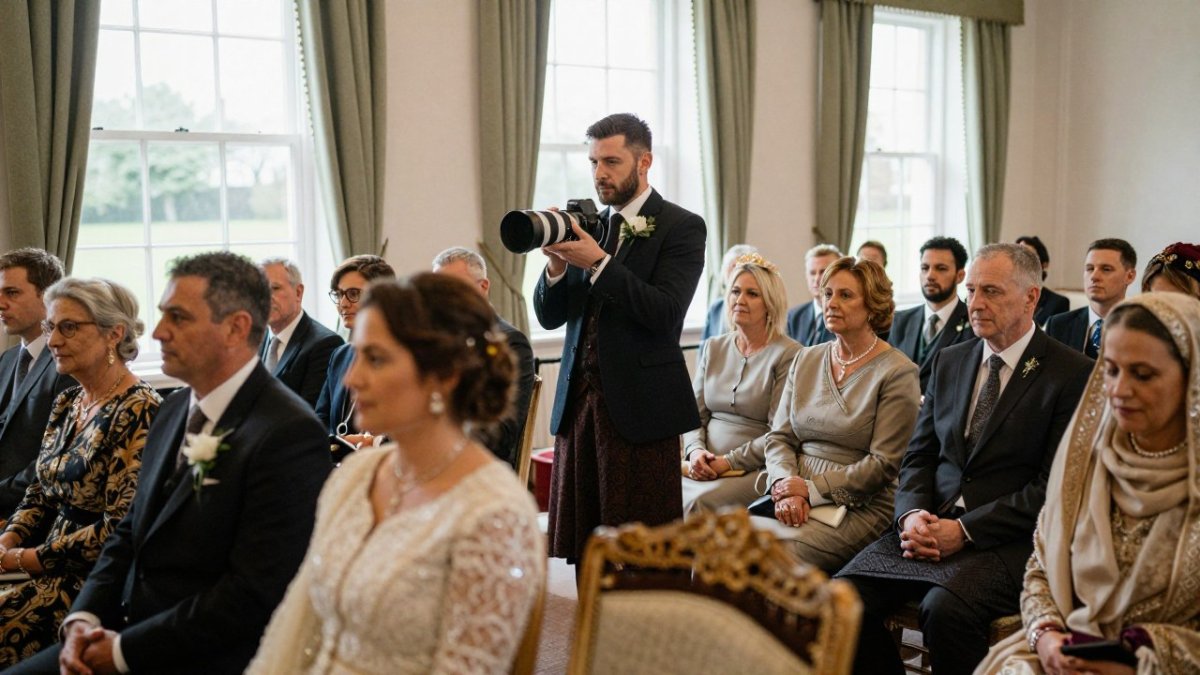
Movement restrictions matter most during prayer and the reading of the contract. Plan them in advance so nobody has to intervene on the day.
Secure Delivery, Retention and Deletion of Images
Privacy does not end when the wedding does. The images of a Nikah often include family members who do not appear on social media, women-only gatherings, and moments the couple has marked private. Delivery and retention need to be planned with the same care as the ceremony itself.
A password-protected gallery with named access is the standard to expect. But "password-protected" means little without a defined access model, a retention period, and a deletion process confirmed in writing.
Gallery Access and Download Permissions
Ask the photographer to set up the gallery so that access is named, not shared. Clarify with your photographer how the gallery is structured, who holds the master password, and whether download permissions can be set per gallery.
Ask who holds the master password and whether the couple can revoke access for a named guest without contacting the photographer. If the answer is no, ask for a process that lets them do it.
Retention, Backups and Deletion
Get the retention period in writing. Ask these questions:
- How long are full-resolution files retained after delivery?
- Are backups encrypted, and where are they stored?
- Are backups deleted at the same time as the primary files, or later?
- What is the deletion process, and will it be confirmed in writing?
If a photographer cannot say how long they keep files, that is your answer. The couple should know which retention terms apply to them before booking.
Nikah-Specific Sharing Limits
Gender-segregated images need their own rules. If a female photographer covered the women's gathering, those images should sit in a separate sub-gallery with access limited to the couple and named family members. Ask the photographer not to include them in any portfolio, blog, or vendor sharing without a separate written release.
Family-only moments, the signing with close relatives, the bride's getting-ready room, should be marked as private in the delivery notes, so anyone handling the files after the wedding knows not to share them.
A Written Deletion Request
If the couple wants files deleted earlier than the standard retention period, put the request in writing. A short email works:
"Please confirm that all full-resolution files from our Nikah, including backups, will be permanently deleted by [date]. Please confirm by reply when deletion is complete."
Ask for confirmation in writing, and keep the reply with the contract. A professional will not be offended; most will simply follow their standard process and confirm it.
Watch out: a gallery that stays open indefinitely is a privacy risk, not a convenience. Confirm the access terms for your gallery in writing before delivery.
Privacy at a Nikah is not a restriction on good photography. It is what makes honest, relaxed images possible, because everyone in the room knows the boundaries. Khush Studio has covered Indian, Sikh and Muslim weddings for over twenty years, with a discreet approach, tailored packages and a private gallery for every couple. If you are planning a Nikah and want coverage that respects your family's wishes, view our Muslim wedding photography service and enquire with your date.
Frequently Asked Questions
How can we keep our Nikah wedding photos private?
Start by agreeing your privacy preferences with your photographer in writing before the wedding day. Ask for a password-protected private gallery rather than a public one, and confirm whether images can be used in portfolios or on social media. For the ceremony itself, discuss positioning, flash restrictions and which moments should not be photographed. A written wedding photography privacy agreement removes guesswork and gives you a clear record of what was agreed.
Can we ask our photographer not to share our wedding photos online?
Yes, and you should raise it early. Ask how to ask a photographer not to post photos during your first consultation, then have the answer written into your contract. Specify that no images go on social media, websites or portfolios without your written approval, and agree how long images are retained and when they are deleted. Reputable photographers expect this request and will confirm their image-use permissions in the agreement.
How do we handle photography in women-only areas during the Nikah?
Agree in advance whether a female photographer or videographer will cover women-only spaces, and confirm who may enter and when. Build these moments into your Nikah photography shot list as separate, clearly defined segments. Brief the photographer on modesty requirements, sightlines and any guests who must not appear on camera. A pre-wedding consultation covering gender-segregated spaces prevents awkward moments on the day.
How can guests be asked not to take or share photos at a Nikah?
Set wedding photo sharing rules for guests and communicate them more than once: on the invitation, on signage at the venue and in a short announcement before the ceremony. Ask guests to keep phone cameras away during the Nikah and offer a camera-free zone for anyone who prefers not to be photographed. If you want a firm approach, use camera privacy pouches at the entrance and appoint a family member to remind guests politely.