 How-to
Is Drone Footage Worth It for Asian Weddings?
Last Updated: November 21, 2026
Quick Summary
Asian wedding videography drone footage is worth it because it captures the scale and movement that ground cameras cannot, such as a baraat procession, a marquee at dusk or hundreds of guests at a single ritual. Drone footage also ties multi-day, multi-venue celebrations into one visual story.
- Drone permissions need two approvals: venue consent and compliance with UK CAA aviation rules.
- A drone flight typically lasts 15 to 20 minutes per battery, with 10 minutes to set up and land.
- Plan three or four flight windows rather than keeping the drone up all day.
- A drone cannot legally fly directly over a dense crowd, so baraat shots are filmed from a safe offset angle.
- Build a 20-minute buffer into the schedule because baraat processions rarely run to time.
Table of Contents
- Why Drone Footage Suits Asian Wedding Celebrations
- Wedding Videography With Drone Footage: What It Adds to a Multi-Day Wedding
- Drone Permissions, Venue Consent and UK Aviation Rules
- A Practical Drone Shot List for the Baraat, Ceremony and Reception
- Wedding Drone Photography vs Video: What Each Actually Delivers
- Weather, Safety and Backup Plans for Outdoor Filming
- How to Choose an Asian Wedding Videographer Who Flies Drones
- Enquire About Drone Coverage for Your Wedding
- Frequently Asked Questions
Why Drone Footage Suits Asian Wedding Celebrations
Asian wedding videography drone footage works because it captures scale and movement that ground cameras simply cannot. A baraat winding through a venue's grounds, a marquee glowing at dusk, hundreds of guests gathered for a single ritual: these are moments built for an aerial wide shot. At Khush Studio, we have filmed Indian, Sikh and Muslim weddings for over 20 years.
The reason is structural. Asian weddings are rarely confined to one room or one moment. They move, often across several days and venues, and drone footage is the only tool that shows that movement as a single, cinematic picture.
- The baraat procession reads as a river of colour from above
- Multi-day venues can be introduced in one sweeping establishing shot
- Outdoor ceremonies gain a sense of place that close-ups lose
Below, we break down what drone footage adds to a wedding and how to choose a videographer who flies safely and legally.
Wedding Videography With Drone Footage: What It Adds to a Multi-Day Wedding
Wedding videography with drone footage adds an establishing shot, scale, and continuity that a ground crew alone cannot deliver. On a three-day celebration, that continuity matters most: the aerial view ties the mehndi, the ceremony and the reception into one visual story, even when each event happens at a different venue.
A common mistake is treating drone footage as a highlight-reel gimmick. In practice, it does the quiet work of orientation. Guests watching the final film immediately understand where they are and how the celebration unfolded. If your events span several venues, it is worth reading our guide to why multi-day Asian weddings need their own film crew before you decide on add-ons.
| Coverage Type | What It Captures | Best For |
|---|---|---|
| Ground cinematic | Close emotion, ritual detail, guest reactions | Ceremony, vidai, intimate moments |
| Documentary style | Full-length record of events | Family archive, elders |
| Aerial drone | Scale, venue, procession, landscape | Baraat, outdoor ceremonies, establishing shots |
Drone Permissions, Venue Consent and UK Aviation Rules
Drone permissions require two separate approvals: the venue's consent and compliance with UK aviation rules. Most venues have their own drone policy, and some historic or listed sites prohibit flights outright. Always confirm in writing before the day.
The flying itself is governed by the Civil Aviation Authority. Under CAA drone and model aircraft rules, commercial operators must hold the correct flyer and operator registrations, and flights must respect privacy and crowd-distance requirements. A professional videographer will handle this paperwork and carry insurance. Ask to see it. If a supplier cannot explain their registration, that is your answer.
What the CAA framework actually requires of a commercial drone operator is more specific than most couples realise. Ask your videographer to show proof of their CAA registration and insurance before you book. A legitimate supplier will provide these without hesitation.
Airspace is the next layer. Much of the UK is open to drone flights below 120 metres, but restrictions apply near airports, military zones, prisons and some built-up areas. A professional pilot checks a CAA-approved airspace map for your venue's postcode before the wedding day, not on the morning. If your venue sits inside a Flight Restriction Zone, the operator may need to request permission from the controlling authority, a process that can take several days.
Privacy law matters too. Filming guests from the air involves handling personal data, so a professional operator should be able to explain how footage is stored and shared. Ask about this before you book.
Watch out: a drone cannot legally fly directly over a dense crowd, so a baraat shot is usually filmed from a safe offset angle, not straight overhead. The CAA's crowd-distance rules mean the pilot must maintain a horizontal separation from uninvolved people, and a baraat procession counts as a crowd.
Venue consent has its own practical rhythm, and approvals should be built into your planning timeline well in advance of the event. If your ceremony is in a place of worship, the committee or officiant may have their own rules about drones near the building. Build these approvals into your planning timeline alongside the catering and decor decisions.
A Practical Drone Shot List for the Baraat, Ceremony and Reception
A drone shot list should be agreed before the wedding so the pilot knows exactly which moments to capture. Here is the sequence we plan with couples.
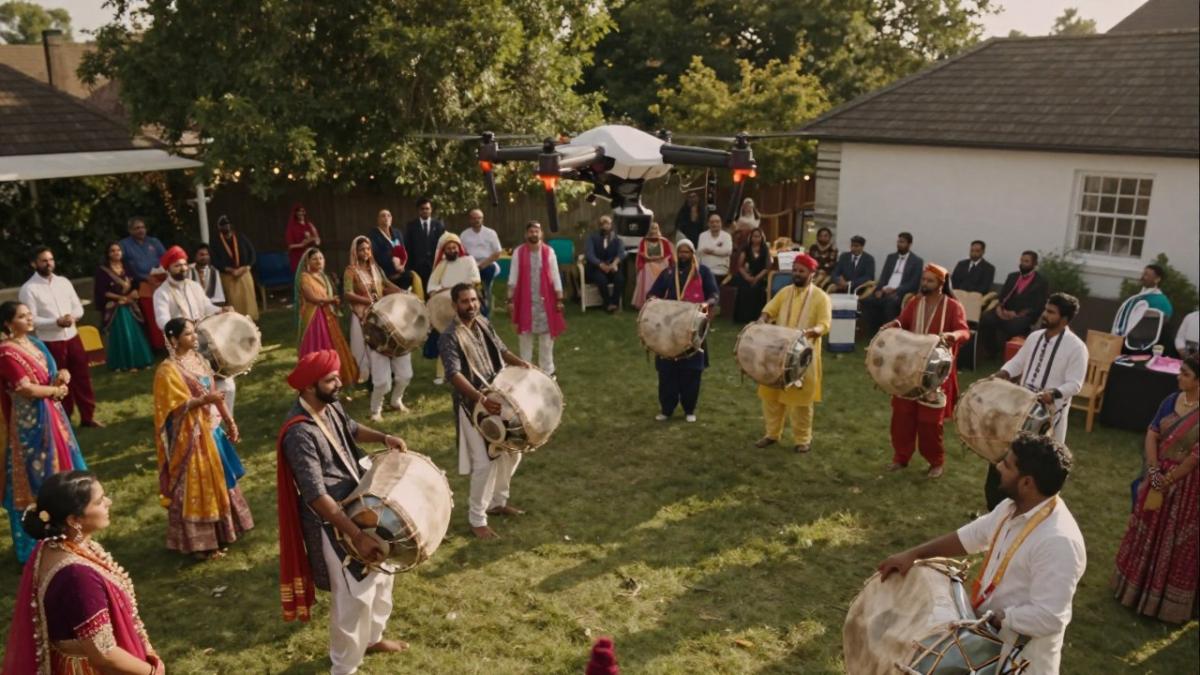
- Venue establishing shot (arrival, 5 minutes): a slow reveal of the grounds
- Baraat approach (procession): a tracking wide shot following the groom's party
- Ceremony exterior (before rituals): the mandap or marquee from above
- Guest arrival wide (pre-ceremony): the gathering filling the space
- Golden-hour orbit (early evening): a gentle circle around the couple
- Reception reveal (dusk): the lit venue as the celebration begins
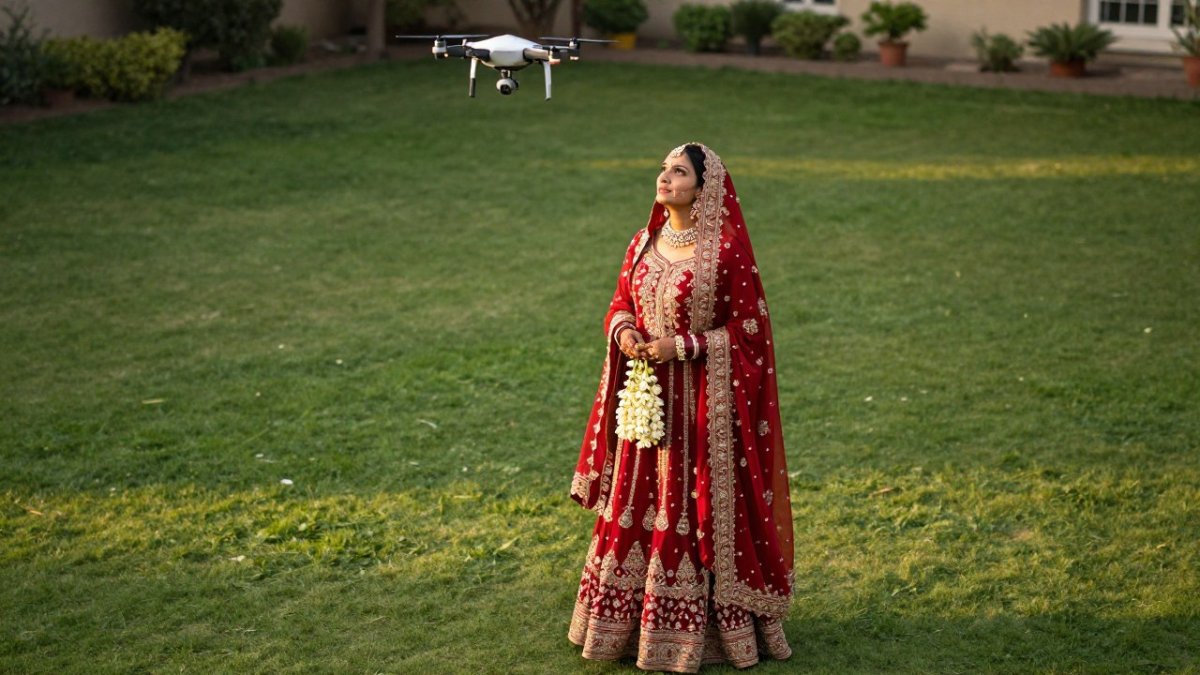
The sequence above is the skeleton. What makes it work on the day is the timeline around it. A drone flight typically lasts 15 to 20 minutes per battery, and the pilot needs 10 minutes to set up, calibrate and land safely. That means each aerial moment is a short, planned window, not a continuous presence. Build the shot list around three or four flight windows rather than trying to keep the drone up all day.
A realistic wedding-day timeline looks like this. The pilot arrives with the ground crew, walks the venue with the planner, and identifies take-off and landing zones away from guest foot traffic. The first flight happens 30 to 45 minutes before the baraat is due to arrive, capturing the empty venue and the mandap or marquee in clean light.
Coordination between the drone and ground cameras is the part couples underestimate. The pilot and the lead videographer should share a radio or a messaging thread so they know when the ground crew is moving in for close-ups and when the drone needs clear air.
For a fuller breakdown of which moments to prioritise across every event, our Asian wedding videography shot list covers the ground and aerial angles in detail. The key is coordination: the drone and ground cameras must never compete for the same moment.
Watch out: the baraat is the most requested aerial shot and the hardest to schedule. Processions rarely run to time, and the pilot cannot hover indefinitely waiting for the groom's party to appear. Build a 20-minute buffer into the schedule and agree a signal, a radio call or a WhatsApp message, so the pilot knows when the baraat is five minutes away.
Wedding Drone Photography vs Video: What Each Actually Delivers
Wedding drone photography and drone video serve different purposes, and couples often assume one replaces the other. Aerial stills give you striking framed images for albums and prints; aerial video gives you motion, scale and story. Most couples want both, captured in the same flight to save time.
Aerial stills suit large group portraits and venue features. Aerial video suits the baraat, the procession and the transition between events.
Weather, Safety and Backup Plans for Outdoor Filming
Weather is the single biggest threat to an aerial shot, and a professional plan accounts for it in advance. High wind, rain and low cloud can ground a drone entirely, and no videographer can override safety limits.
A sensible backup plan includes a ground-crew alternative for every aerial shot, a weather check the day before, and a flexible window built into the schedule. If the forecast turns, the establishing shot becomes a crane or gimbal shot instead. You still get the wide view, just from a different height. Ask any supplier what their contingency is before booking.
How to Choose an Asian Wedding Videographer Who Flies Drones
Choosing an Asian wedding videographer who flies drones comes down to three checks: cultural fluency, verified credentials, and a portfolio that matches what you want delivered. Cultural understanding is not optional. A videographer who does not recognise the significance of the Anand Karaj or the Nikah will miss the moments that matter.
Use this checklist when you interview suppliers:
- Can they explain the rituals they will film without prompting?
- Do they hold current CAA registration and insurance?
- Have they flown at your venue, or will they confirm consent first?
- Does their portfolio include full-length films, not just highlight reels?
- What is their backup plan for weather or equipment failure?
- Do they work outside the major cities, and how often?
Our guide to choosing an Asian wedding videographer walks through the interview questions in full. For a sense of how multi-day coverage and packages are structured, see our three-day Asian wedding videography coverage guide.
Enquire About Drone Coverage for Your Wedding
Deciding on aerial footage is really a question of what you want to remember. If the scale of your celebration, the procession, the venue and the gathering of everyone you love, matters to you, drone footage earns its place. Khush Studio brings over 20 years of experience filming Indian, Sikh and Muslim weddings, a discreet approach to documenting events, and tailored packages.
Get started with Khush Studio and capture your celebration from every angle, on the ground and in the air.
Enquire about drone coverage for your wedding and we will talk you through what suits your venues and dates.
Every celebration has a moment that only an aerial view can do justice. If you want that shot in your film, the right time to plan it is now, before the venue and schedule are locked. Khush Studio offers tailored videography packages, a discreet and culturally attuned team, and over two decades of experience preserving Asian wedding traditions. Get started with Khush Studio and secure aerial coverage that honours every ritual.
Frequently Asked Questions
Can you use a drone at a wedding venue?
Only with the venue's consent and within UK Civil Aviation Authority rules. Many venues, particularly listed buildings, estates near airports, or those in congested areas, restrict or ban drone flights, so permission should be confirmed in writing before the day. An experienced Asian wedding videographer will check venue restrictions during planning and hold the correct flyer ID and insurance. If the venue refuses, aerial shots can sometimes be captured at a nearby location such as the couple's home or a hotel grounds earlier in the day.
Is drone footage suitable for every wedding venue?
No. Drones work best over open outdoor spaces: processions, venue exteriors, landscaped grounds and wide landscape establishing shots. Indoor ceremonies, marquees with low ceilings and tightly packed urban streets are unsuitable for safety and signal reasons. A good Asian wedding videographer will tell you honestly which moments suit aerial coverage and which are better served by gimbal, crane or handheld cameras, so the final film stays consistent rather than gimmicky.
What happens if bad weather prevents drone filming?
Drones cannot fly safely in heavy rain or strong wind, and most operators will not launch in poor visibility. A reliable team builds a backup plan into the schedule: a reserve slot on another event day, ground-based cinematic coverage of the same moments, and a weather check 24 to 48 hours ahead. Discuss this contingency when you book, and ask whether any aerial add-on is adjusted if flying becomes impossible.
How much does wedding videography with drone footage cost?
Pricing depends on the number of events, days of coverage, final film length and whether aerial footage is included or added on. Multi-day Asian weddings with several venues need more crew and editing time than a single-day celebration, so quotes vary widely. Ask for a written breakdown covering filming hours, drone coverage, editing and delivery formats, and request sample films that include aerial shots so you can judge the quality before committing.